What is aerospace engineering, really?
Aerospace engineers take a mission (cross an ocean, keep a satellite pointed at Earth, fly a camera through a forest) and turn it into a vehicle that does it safely and on budget.
Officially, they design, develop and test aircraft, spacecraft, satellites and missiles.1 In practice, nobody designs “the plane.” Each engineer owns a slice and spends much of their time making it work with everyone else’s.
Aerodynamics
How air flows around the vehicle and creates lift and drag.
Feeds structures (air loads) and controls (stability).
Propulsion
Jets, propellers, electric motors and rockets: making thrust efficiently.
Sets the mass budget and range.
Structures
Sizing the frame and skin to carry loads while staying light.
Trades directly with materials and aerodynamics.
Materials
Aluminium, titanium, composites, and how each fails.
Limits what structures and manufacturing can do.
Controls & GNC
Keeping the vehicle stable, knowing where it is, and steering it where it should go.
The core of autopilots, drones and spacecraft.
Orbital mechanics
The paths spacecraft follow and the energy needed to change them.
Drives propulsion and mission design in space.
Systems engineering
Making sure every piece fits together and meets the requirements.
Touches every other discipline.
Autonomy
Software that lets a vehicle perceive, plan and decide without a pilot.
Built on GNC, controls and code.
↺ Test results loop back up and can change the requirements.
Air or space?
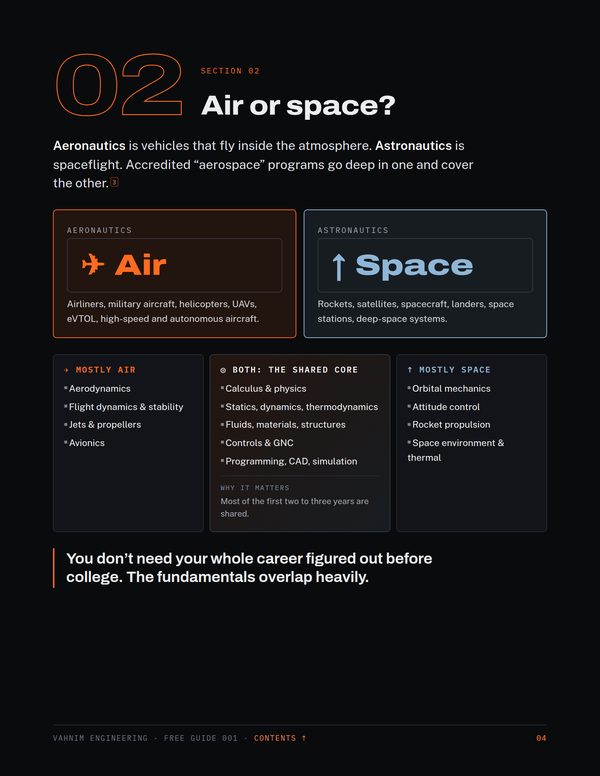
Aeronautics is vehicles that fly inside the atmosphere. Astronautics is spaceflight. Accredited “aerospace” programs go deep in one and cover the other.3
✈ Mostly air
- Aerodynamics
- Flight dynamics & stability
- Jets & propellers
- Avionics
◎ Both: the shared core
- Calculus & physics
- Statics, dynamics, thermodynamics
- Fluids, materials, structures
- Controls & GNC
- Programming, CAD, simulation
↑ Mostly space
- Orbital mechanics
- Attitude control
- Rocket propulsion
- Space environment & thermal
You don’t need your whole career figured out before college. The fundamentals overlap heavily.
What should you actually be good at?
Algebra, trig, then calculus. You don’t need advanced math before college; you need to be willing to practise.
Forces, motion, energy, fluids. Understanding what an equation means beats memorising it.
Real problems aren’t “find x.” They’re trade-offs: mass vs strength, speed vs efficiency, performance vs cost.
“Why does that work?” and “What if I change this?” are already engineering instincts.
- Design
Make your best guess from the requirements.
- Test
Build or simulate it and measure what happens.
- Fail
Something doesn’t match. This is normal.
- Understand
Work out why. The failure shows what your model got wrong.
- Change
Adjust the design based on what you learned.
- Test again
Repeat until it works. Real vehicles go round this loop many times.
A failed test is information, not proof you’re bad at this.
What will you actually study?
Science, then general engineering, then aerospace, with hands-on design throughout. Exact courses vary by university.
≈ Year 1
Foundation
- Calculus
- Physics
- Chemistry
- Programming
- Intro to engineering
≈ Years 1–2
Core engineering
- Statics
- Dynamics
- Thermodynamics
- Fluid mechanics
- Materials
- Mechanics of materials
≈ Years 2–3
Aerospace
- Aerodynamics
- Aircraft performance
- Propulsion
- Flight dynamics
- Controls
- Structures
- Orbital mechanics
Throughout · peaks in year 4
Application
- Labs
- CAD
- Simulation
- Design projects
- Capstone design
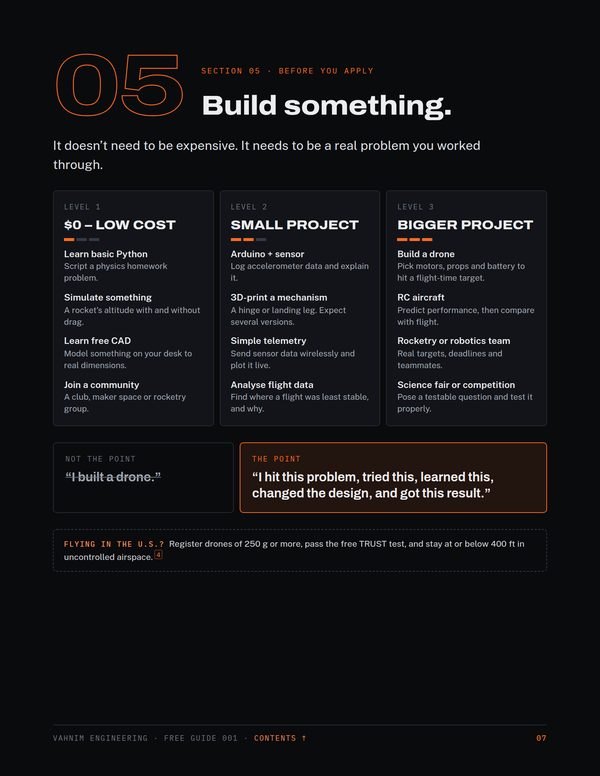
Build something.
It doesn’t need to be expensive. It needs to be a real problem you worked through.
Level 1 · $0 – low cost
Learn basic Python
Write a script that solves a physics homework problem.
Simulate something
Model a rocket’s altitude with and without drag.
Learn free CAD
Model an object on your desk with real dimensions.
Join a community
A club, maker space or rocketry group.
Level 2 · Small project
Arduino + sensor
Log accelerometer or barometer data and explain it.
3D-print a mechanism
A hinge or landing leg. Expect several versions.
Simple telemetry
Send sensor data wirelessly and plot it live.
Analyse flight data
Find where a drone flight was least stable, and why.
Level 3 · Bigger project
Build a drone
Pick motors, props and battery to hit a flight-time target.
U.S. flyers: register drones of 250 g or more, pass the free TRUST test, and stay at or below 400 ft in uncontrolled airspace.4
RC aircraft
Predict its performance, then compare with flight.
Rocketry or robotics team
Real targets, deadlines and teammates.
Science fair or competition
Pose a testable question and test it properly.
“I built a drone.”
“I hit this problem, tried this, learned this, changed the design, and got this result.”
Before you commit to the major
Ask yourself honestly. There’s no score. You make the call.
An unchecked box isn’t a no. It’s something to try before you decide.
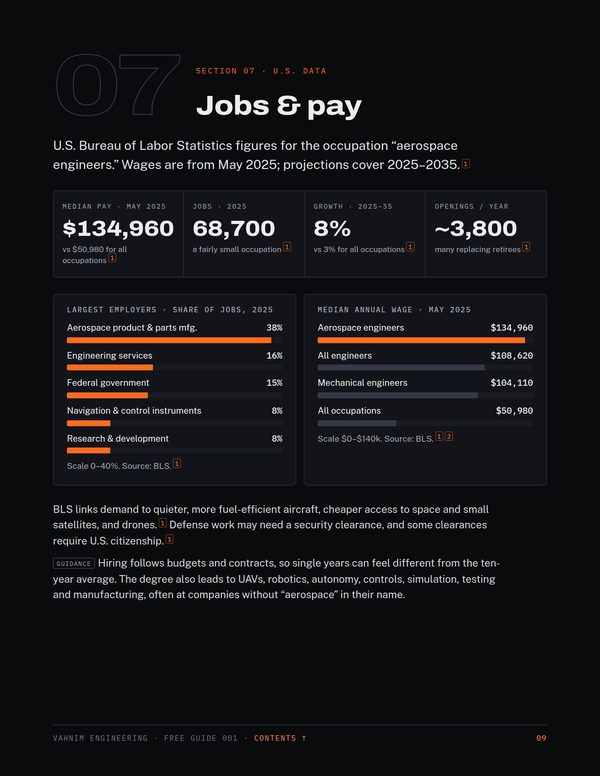
Jobs, pay & aerospace vs mechanical
Source: BLS, “aerospace engineers.” Typical entry-level education: a bachelor’s degree.1
Largest employers · share of aerospace engineering jobs, 2025
- Aerospace product & parts manufacturing
- 38%
- Engineering services
- 16%
- Federal government
- 15%
- Navigation & control instruments mfg.
- 8%
- Research & development
- 8%
Source: BLS.1 Remaining jobs are spread across other industries.
BLS links demand to quieter, more fuel-efficient aircraft, cheaper access to space and small satellites, and drones.1 Defense work may need a security clearance, and some clearances require U.S. citizenship.1 The degree also leads to UAVs, robotics, autonomy and controls, often at companies without “aerospace” in their name.
Aerospace or mechanical?
| Aerospace | Mechanical | |
|---|---|---|
| Focus | Aircraft, spacecraft, satellites, missiles1 | Machines, engines, tools, thermal systems, robots2 |
| U.S. jobs, 2025 | 68,7001 | 298,5002 |
| Median pay, May 2025 | $134,9601 | $104,1102 |
| Growth, 2025–35 | 8%1 | 11%2 |
| Best fit if… | Aircraft or spacecraft are what excite you | You want the broadest engineering base |
Figures describe people working in each occupation, not graduates of each degree. Engineers from both degrees work in aerospace.
What parents should know
Is it too specialised?
Do they need to be exceptional at math already?
No. Programs teach calculus and beyond. BLS recommends high school chemistry, physics and math.1
How important are internships and projects?
BLS notes co-ops and internships give practical experience during school.1 Guidance Both are the clearest evidence a student can do real engineering work, and projects come first, before internships are possible.
Is graduate school expected?
Not usually. A bachelor’s is the typical entry-level education; graduate degrees help mainly for research and teaching.1
What should we check when picking a school?
ABET accreditation. A degree from an accredited program is usually required for a Professional Engineering license later.1
You don’t become an engineer when someone hands you the degree. You start the first time you work a problem like this:
Resources & references
Go further (free)
References
All accessed September 25, 2026. Vahnim Engineering is independent and not affiliated with or endorsed by BLS, ABET, the FAA, NASA or any organisation listed; links go to their official websites.